· Blogging the Ex-Mormon And Mormon World - by Infymus.
· News, Recovery, Information, Humor & More.
· Racking up 1310 Packer Penalty Points and pissing off Daniel Peterson since May, 2004.
|
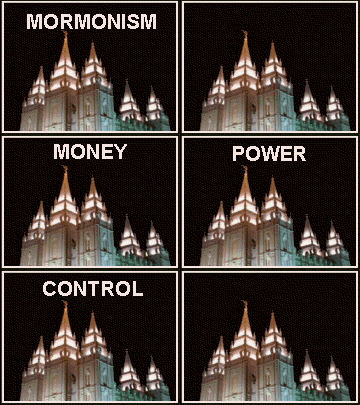
Temple Rituals
|
MORMON TEMPLES AND TEMPLE RITUALS
by Richard Packham
|
The purpose of this article is to give a quick overview of the nature of
Mormon temples and their rituals, and to direct the reader who wishes more
detail to appropriate sources. | |
One of the most visible characteristics of the Mormon church (officially
"The Church of Jesus Christ of Latter-day Saints", also called the "LDS
Church") is its temples. These imposing structures, situated on beautifully landscaped sites, attract attention; they are
often local landmarks. As late as the 1950's there were scarcely a handful of
such temples in existence, four of them in Utah, and one each in Hawaii,
Alberta, Arizona and Idaho. (The first Mormon temple to be built, in the
1830s, is still standing in Kirtland, Ohio, but is no longer owned by the
church, and was not designed or used for the same rituals as the later
temples.) Since the 1960's, however, the church has built an imposing temple
in most of the major cities of the world, and there are now over one hundred
worldwide.
Mormon temples are quite different, both in design and use, from the
buildings where Mormon congregations hold their weekly worship services. On
Sundays Mormons gather for meetings, sermons and simple worship in the local
"chapel" or "meeting house" or "ward house" or "church" (these terms are used
interchangeably by most Mormons). Mormons go to the temple only on weekdays,
never on Sunday - the temples are closed on Sundays. Some Mormons go to the
temple quite regularly; others rarely, since for many Mormons the nearest
temple may be hundreds of miles from their home. Temples are closed to the
public and also to Mormons who do not qualify as sufficiently "worthy." The
rituals in the temples - especially the "endowment" - are considered so sacred
that Mormons are forbidden to discuss them outside the temple itself.
Even non-Mormons sometimes object to articles such as this, since they
reveal Mormons' religious secrets to a curious - and perhaps unworthy and even
mocking - world. Many people, not only devout Mormons, feel that it is wrong
to do this. Usually two reasons for the objection are given: 1) things that
anyone holds sacred should not be profaned, mocked or ridiculed by anyone
else, even by one who does not consider them sacred; and 2) the person who is
revealing the secrets usually is someone who obtained the secrets only by
swearing an oath of secrecy, and thus is breaking an oath.
As to the first objection, this article does not "mock" or "ridicule" the secrets of the Mormon temple; it merely reveals them. Also, it seems rather odd to refuse to discuss
objectively and openly any subject just because someone else feels that
subject is taboo. I doubt that many Mormons would refuse to discuss the
sacred initiation rituals of some primitive African tribe or some Satanist
cult on the grounds that the tribe or cult considered those rites sacred.
As to the second objection, the validity and binding nature of an oath
or any promise depends, both legally and morally, upon the validity of the
mutually accepted facts underlying the demanding and the giving of the oath.
The oath of secrecy given by a Mormon in the temple is based on the assurance
and sacred promise that the oath is required by God, and that the secrets one
will receive are given by God. If that assurance is in fact false, then one
cannot be bound either legally or morally by any such oath, since it was
obtained by a lie. (For further discussion of this issue, click here.)
The rituals (Mormons call them "ordinances") performed in the temple
are:
- Baptism for the dead
- Endowment for the dead and the living
- Sealings for the dead and the living
- Sealing of husband and wife (marriage)
- Sealing of children to parents
- Second Anointing (or Second Endowment)
Ordinances are performed for the dead in the belief that those who have
died without going through the rituals necessary for salvation and exaltation
must still have the opportunity to have these ordinances performed.
Therefore, a living Mormon will go to the temple and go through the rituals as
a proxy for a dead person, taking the name of that person temporarily. This
"work for the dead" probably consititutes 95% of the ceremonies performed in
the temples. This is the reason for the extensive genealogy work done by
Mormons, since living Mormons are told that they are the ones primarily
responsible for seeing to it that all their own ancestors "have their temple
work done."
Whenever a new Mormon temple is finished, it is always opened to the
public for a few weeks for inspection before it is dedicated. This is the
only opportunity that a non-Mormon (or an unworthy Mormon) will have to see
the inside of a Mormon temple. If there should be a new temple built in your
area, you might consider taking the pre-dedication tour. You will not see any
of the rituals performed, but you will have a chance to see the building and
its furnishings.
Mormons who wish to participate in any of the temple rituals must first
request an interview with the bishop of their local ward (that is, the pastor
of their local Mormon congregation), who will examine them individually as to
their religious beliefs, their loyalty to the church leaders, their abstinence
from forbidden things (alcohol, tobacco, coffee, tea), their sexual morality,
and the extent of their financial contributions to the church. If the bishop
determines from this examination that they are sufficiently worthy, he will
issue them a "recommend," that is, a pass to the temple, valid for two years. (Until 2002 the recommend was valid for only one year.)
The recommend must then be taken to the stake president (the church officer
who oversees several local wards), who will conduct a similar interview before
countersigning the recommend. Many Mormons always carry their recommend,
which is the size of a credit card, in their purse or wallet.
The official questions asked in these interviews can be read here. To see what an actual recommend looks like, click here.
Upon arrival at the temple, a temple worker at the reception desk
examines the recommend and grants admission. Those who do not own their own
temple clothing may rent the necessary clothing items for a small fee. Most
Mormons who regularly attend the temple own their own set of temple clothing and bring it
in a small suitcase or bag.
THE TEMPLE ORDINANCES
BAPTISM FOR THE DEAD
Perhaps the most striking feature inside a Mormon temple is the large
baptismal font, large enough to accommodate several people standing waist-deep
in water. The font rests on the backs of twelve life-size sculpted oxen in a
special room. It is here that baptisms for the dead are performed. The
proxies are usually a group of teen-age Mormons who have travelled from their
homes in a group for a temple excursion. Dressed in white, they line up to
enter the waters one by one to be immersed by the officiators with the short
baptismal prayer: "Having authority given me of Jesus Christ, I baptize you
for and in behalf of N. N., who is dead, in the name of the Father, and of the
Son, and of the Holy Ghost. Amen." The name of the dead person is read from a
list to the officiator just before the immersion. One proxy may be baptized
quickly in succession for ten or fifteen dead people. After the baptisms, two
other officiators confirm the newly baptized dead persons as members of the
Mormon church and confer upon them the gift of the Holy Ghost, by placing
their hands upon the head of each proxy, with a similar short pronouncement.
Hundreds of such baptisms and confirmations can be performed in a few hours.
It is an efficient, production-line operation.
THE ENDOWMENT
The endowment ceremony, unlike baptisms, takes several hours to
complete. Only adult Mormons in very good standing are allowed to
participate.
The endowment ceremony is a kind of initiation rite, consisting of
dramatization, instruction, passwords, oaths, and examinations. It consists
of two parts: a preliminary "washing and anointing" ceremony, and the
endowment itself. The first time a Mormon goes through the endowment
ceremony, it is for himself (or herself), and he participates in both parts.
When being endowed for the dead, it is now customary that one person acts as
proxy for the dead person's washing and anointing, but another person, perhaps
even on a different day, for the rest of the ceremony. Otherwise, the only
difference in the ceremony for the living and for the dead is the insertion of
the phrase "for and in behalf of N. N., who is dead" at appropriate times in
the proxy ceremony.
The washing and anointing ceremony is an individual ritual, but the
second part is a group ritual; that is, a group of Mormons (a "company") goes
through the ceremony at the same time together. There may be as many as six
or eight "endowment sessions" per day at a busy temple, running from early
morning to late in the evening, each with a company of twenty to a hundred
people.
Brigham Young, on the occasion of the laying of the cornerstone of the
Salt Lake temple, described the importance of the endowment as the key to
entrance into the highest degree of heaven:
"Your endowment is to receive all those ordinances in the House of the Lord
which are necessary for you, after you have departed this life, to enable you
to walk back to the presence of the Father, passing the angels who stand as
sentinels, being enabled to give them the key words, the signs and tokens,
pertaining to the Holy Priesthood, and gain your eternal exaltation in spite
of earth and hell." - Journal of Discourses,
Vol. 2, p.315, April 6, 1853
THE ENDOWMENT: THE WASHING AND ANOINTING
Men and women undergo this part of the endowment in separate but
identical areas. Male officiators perform the ritual for the men, and female
officiators for the women. The ceremony is the same for members of each sex,
with the exception of the ordination to the priesthood, mentioned below.
Since women cannot hold the Mormon priesthood, that ordination is not
performed for the women. The description here uses a male example.
Each participant (called a "patron") goes to a locker room and
completely disrobes, removing his street clothes and covering the body with a
loose white poncho. Taking a towel and a "sacred garment" (which will be
discussed later), he proceeds to any one of a number of small booths, where
temple workers ("officiators") are waiting for the individual patrons. Male
patrons who are proxies for dead men are first ordained to the Mormon
priesthood on behalf of the dead man. The ordination is performed by two
temple workers who lay their hands on the patron's head and pronounce a short
ordination formula. The patron enters the booth, and receives the washing,
which consists of a token wetting of each part of the body, accompanied by a
set blessing to the effect that that body part will function properly. The
head, eyes, nose, neck, shoulders, arms, loins, legs, feet, etc. are all
washed and blessed. The two officiators then place their hands upon the head
of the patron and with a short prayer "seal" the washing upon him, thus
"cleansing" him from the "sins of this generation."
The anointing follows immediately, and is identical with the washing,
except that each body part is "anointed," that is, touched with a small amount
of olive oil. The anointing is also sealed upon him.
The officiators then clothe the patron in the "garment of the Holy
Priesthood" which the patron has brought. This is a plain white undergarment
with four small symbolic marks sewn into it, at the right knee, the navel and
each nipple. The patron is instructed that the garment represents the
covering which God gave Adam and Eve to clothe their nakedness, and that the
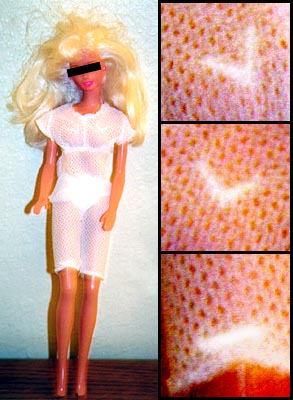
patron must wear such a garment at all times from then onward. (Click here for more on the garment). For a
photograph of a doll dressed in the garment, with close-ups of the markings,
click here. For a photograph of a man and woman wearing only the garments, click here.
At this point the patron is also given a "new name," which will be used
as a password later in the ceremony, and which he is told will also be needed
at the entrance to heaven. The name is usually a name of some character from
the Bible or the Book of Mormon. (Few Mormons are aware that on any given
day, every temple patron of the same sex receives the same new name. For a listing of new names, click here (offsite).)
The patron then goes back to the locker, removes the poncho, and dresses
for the communal part of the endowment in plain white clothing, with the
garment underneath. For men: trousers, belt, shirt, necktie, socks, and
slippers or moccasins. For women: long-sleeved dress, stockings, and slippers
or moccasins.
The patron carries the remaining ritual clothing in a small bag or
packet, and proceeds to a waiting area until everyone in the company is ready
to move into the large auditorium room where the company will be seated (men
on the right side of the room, women on the left) for the start of the
session. These clothing articles are: a small green apron, usually
embroidered with a leaf motif, the "robe," which is actually just a long,
pleated toga-like piece of white cloth to be draped over one shoulder, and the
"sash," a narrow piece of white cloth long enough to be wrapped around the
waist and tied in a bow at the side. Men also have a white cap, resembling a
small chef's hat, and women have a veil which can either hang behind the head
or be brought to the front to cover the face.
Since deceased Mormons are buried in their temple clothing, anyone can
see the actual clothing at a Mormon funeral or viewing of the deceased. (The
cap or veil is usually placed on the deceased's head immediately before the
final closing of the coffin.)
THE ENDOWMENT: THE DRAMA, LAWS, AND COVENANTS
The endowment ritual has undergone a number of major revisions in the
150 years since it was first introduced by Joseph Smith. The most drastic
revision was in 1990, when major parts of the earlier forms of the endowment
were removed, perhaps because even Mormons found them too offensive. The
following description is based on the version as this writer experienced it,
before the 1990 revisions, with comments about the 1990 revisions.
This article will merely summarize very briefly the essentials of the
endowment ceremony. To read the entire liturgy, either in its present version
or in older versions, click here for links.
The ritual is a dramatization of the Mormon interpretation of the
creation and history of the world, emphasizing the Creation, the Fall of Adam,
the expulsion from the Garden, and God's sending to humanity the message of
salvation by means of the messengers Peter, James and John. The main
characters in this ritual drama are God the Father (Elohim), Jehovah, and
Michael (who later appears as Adam), Eve, Lucifer, Peter, James and John. Until 1990
a Christian Minister also appeared in a derogatory role, as a paid servant of Lucifer. Jesus
does not appear in the drama, except as Jehovah, one of the creators of the
world. No principles of doctrine are presented that an attentive Mormon has
not already learned from his pre-endowment studies of Mormonism, other than
perhaps the doctrine that his ultimate celestial exaltation will depend on his
knowing the signs, tokens (handclasps) and passwords which he will
learn during the endowment ritual.
Since the 1960s much of the dramatic part of the presentation has been
presented by using motion pictures. In other words, temples nowadays are movie
theaters, showing the same film, over and over. Prior to the introduction of
the use of film, the dramatization was performed by temple workers. The
dramatic presentations were not theatrical, but ritual. No attempt was made
at verisimilitude or real acting. All characters wore white suits or dresses
(except for Lucifer, who wore a black suit and a Masonic ceremonial apron, and
the Christian minister, who wore ordinary street clothes).
In the older temples, when the dramatization was "live," the company
moved from room to room, symbolic of their progression in receiving the Mormon
gospel. The creation was presented in the Creation Room, the Adam and Eve
story in the Garden Room, man's condition after the fall and his temptations
by false doctrine in the Lone and Dreary World Room, and, after mankind
receives the True Gospel, in the Telestial Room, from which passage through
the Veil of the temple (described below) leads to the Celestial Room. Each
room in the older temples was decorated with appropriate murals. Each room
(except for the Creation Room) also contained a small altar.
In the modern temples the company remains in the same room, which is
merely a motion-picture projection room, with an altar.
All altars in the temple are a simple rectangular box, with a low padded
step or ledge, for kneeling. The top of the altar, at elbow height for one
kneeling at the altar, is also padded.
At appropriate places in the dramatization, the patrons put on part of
the ritual clothing over their other clothing. Immediately after the fall,
for example, the patrons put on the green apron, representing Adam's attempt
to cover his nakedness with fig leaves. Later in the ritual, they add the
robe, sash and cap or veil, symbolic of the receiving of the priesthood by
mankind. (Ironically, although Mormon women don the "robes of the holy
priesthood" during the endowment ritual, women are never ordained to the
Mormon priesthood. Most Mormon males over the age of twelve are ordained to
the priesthood, but no female has ever been ordained.)
At various points during the course of the dramatization, the patrons
are required to stand and covenant to obey five all-inclusive laws. These are
the Laws of Obedience, Sacrifice, The Gospel, Chastity, and Consecration.
As an example, here is how the Law of Obedience was presented in the
version from the 1980s:
ELOHIM: We will put the sisters under covenant to obey the law of Obedience to
their husbands. Sisters, arise. (Female patrons stand as instructed.)
ELOHIM: Each of you bring your right arm to the square. You and each of you
solemnly covenant and promise before God, angels, and these witnesses at this
altar that you will each observe and keep the law of your husbands, and abide
by his counsel in righteousness. Each of you bow your head and say "Yes."
WOMEN: Yes.
ELOHIM: That will do.
(The female patrons now resume their seats.)
ELOHIM: Brethren, Arise.
(Male patrons stand as instructed.)
ELOHIM: Each of you bring your right arm to the square. You and each of you
solemnly covenant and promise before God, angels, and these witnesses at this
altar that you will obey the law of God, and keep his commandants. Each of you
bow your head and say "yes".
MEN: Yes.
In the 1990 revisions this Law was changed so that the woman is not
required to "obey" the husband, but to "obey the Law of the Lord, and to
hearken unto the counsel of her husband, as her husband hearkens unto the
counsel of the Father."
The Law of Sacrifice is explained as based on the Old and New
Testaments. In submitting to this Law, the patrons covenant to "sacrifice all
that we possess, even our own lives if necessary, in sustaining and defending
the Kingdom of God [i.e., the Mormon church]."
The Law of the Gospel requires the patrons to covenant to obey the
Gospel (as taught by the Mormon church) and "to avoid all lightmindedness,
loud laughter, evil speaking of the Lord's anointed (i.e., the leaders of the
Mormon church), the taking of the name of God in vain, and every other unholy
and impure practice."
The Law of Chastity is a covenant to restrict one's sexual relations to
the lawful spouse.
The Law of Consecration requires "that you do consecrate yourselves,
your time, talents and everything with which the Lord has blessed you, or with
which he may bless you, to the Church of Jesus Christ of Latter-day Saints,
for the building up of the Kingdom of God on the earth and for the
establishment of Zion."
THE ENDOWMENT: TOKENS, SIGNS AND PENALTIES
At various points in the dramatization, in addition to the making of the
covenants to keep the various laws, the patrons don the robe, sash and
cap/veil - the "robes of the priesthood." The patrons move through the steps
pertaining to the Aaronic Priesthood wearing the robe on the left shoulder,
then move the robe to the right shoulder for the rituals for the Melchizedek
(higher) Priesthood. Each priesthood has two "tokens, signs and penalties"
(only three penalties were actually stated, and in 1990 even those three were
eliminated), which the patrons are given in sequence as part of their
initiation. Each token also has a name which must be learned.
The tokens are special handclasps, with one person "giving" the token
and the other person "receiving" it. The signs are positions in which the
arms and hands must be held. These tokens and signs are methods of
identifying oneself as endowed. Although no Mormon would use this means of
identifying himself outside the temple, the implication is that one will be
asked to show these signs and tokens for admission to the Celestial Kingdom.
The penalties, which were completely deleted from the ceremony in 1990,
are stylized indications of various ways of being killed. It was understood
that anyone revealing these signs or tokens was expressing willingness to
suffer the corresponding penalty and lose his life. As each token and sign is
presented to the company, each patron receives the token from an officiator
and the company makes the sign (and, formerly, enacted the execution of the
penalty) in unison.
FIRST TOKEN OF AARONIC PRIESTHOOD:
The First Token of the Aaronic Priesthood is given by clasping the right
hands and placing the joint of the thumb directly over the first knuckle of
the other person's hand.
The name of this token is the New Name that was received in the washing
and anointing ceremony.
The sign is made by bringing the right arm to the square, the palm of
the hand to the front, the fingers close together, and the thumb extended.
The execution of the Penalty was represented by placing the right thumb
under the left ear, the palm of the hand down, and by drawing the thumb
quickly across the throat to the right ear, and dropping the hand to the
side.
The officiator in the pre-1990 version, after demonstrating the sign and
execution of the penalty, said:
"I will now explain the covenant and obligation of secrecy which are
associated with this token, its name, sign and penalty, and which you will be
required to take upon yourselves. If I were receiving my own Endowment today,
and had been given the name of "John" as my New Name, I would repeat in my
mind these words, after making the sign, at the same time representing the
execution of the penalty: I, John, covenant that I will never reveal the
First Token of the Aaronic Priesthood, with its accompanying name, sign, and
penalty. Rather than do so, I would suffer my life to be taken."
The Officiator demonstrated the execution of the penalty while saying the last
sentence. The company was then instructed to stand, and while making the sign, recite the oath in
unison while executing the penalty. The present-day version is similar, but
without stating or demonstrating the penalty.
SECOND TOKEN OF AARONIC PRIESTHOOD (received with robe on left shoulder):
This Token is given by clasping the right hands and placing the joint of
the thumb between the first and second knuckles of the hand.
The name of this token is one's own first given name if going through
the temple for one's own endowment, or, if going through for the dead, it is
the first given name of the dead person.
The sign is made by bringing the right hand in front, with the hand in
cupping shape, the right arm forming a square, and the left arm being raised
to the square.
The Execution of the Penalty was represented by placing the right hand
on the left breast, drawing the hand quickly across the body, and dropping the
hands to the sides. The oath was similar to the previous penalty oath.
FIRST TOKEN OF MELCHIZIDEK PRIESTHOOD, OR SIGN OF THE NAIL (with the robe on
the right shoulder):
This token is received by bringing the right hand into this position:
the hand vertical, the fingers close together, and the thumb extended; and the
person giving the token placing the tip of the forefinger of his right hand in
the center of the palm, and the thumb opposite on the back of the hand of the
one receiving it. As indicated by its nickname, it represents the nails in
Jesus' palm when he was crucified.
The sign is made by bringing the left hand in front of you with the hand
in cupping shape, the left arm forming a square; the right hand is also
brought forward, the palm down, the fingers close together, the thumb
extended, and the thumb is placed over the left hip. (For a photograph of two Mormon men in their temple robes making the "first sign of the Melchizedek priesthood, click here.)
The penalty was represented by drawing the thumb quickly across the body
and dropping the hands to the sides. The oath is similar to the previous
oaths.
The name of this token is "the Son", meaning the Son of God.
SECOND TOKEN OF THE MELCHIZEDEK PRIESTHOOD, THE PATRIARCHAL GRIP, OR SURE SIGN
OF THE NAIL
This token is given by clasping the right hands, interlocking the little
fingers, and placing the tip of the forefinger upon the center of the wrist.
The thumbs should be parallel with the fingers.
The sign is made by raising both hands high above the head, and while
lowering the hands three times repeating aloud the words: "Pay Lay Ale; Pay
Lay Ale; Pay Lay Ale." The hands are lowered in three distinct movements, one
move for each word. [1] Pay--hands above head, [2] Lay--both arms dropped to
the square, [3] Ale--both hands lowered to the height of chest.
The words spoken when giving the sign of this token are said to mean "Oh
God, hear the words of my mouth!" Since 1990, the original name has been
abandoned in favor of the translation. The reason for the change may be that
too many people heard the name as "Pale Ale Ale," and, since alcoholic
beverages are strictly forbidden in Mormonism, there was confusion.
The name is not given at the time the token is given, but is withheld
until the patron is at the veil, at the very end of the endowment (see
below).
No specific penalty was given to accompany this sign, but the obligation
of secrecy was said to be the same as for the other signs and tokens which had specifically stated
penalties.
THE ENDOWMENT: THE TRUE ORDER OF PRAYER
After the company has received all the signs and tokens of the
priesthood, they are instructed in the "true order of prayer." A circle is
formed by some members of the company standing around the altar, facing the
altar, and alternating by sex if possible. The officiator stands at the altar
and leads the circle through all the signs of the priesthood, the last being
the sign of the Second Token of the Melchizedek priesthood, the words of which
are, "Oh, God! Hear the words of my mouth!"
At this point, the officiator kneels at the altar. The women move their
veils so as to cover their faces. The members of the circle join with the
Patriarchal Grip, each man with the woman to his left, raising the left arm to
the square and resting it on the shoulder or arm of the person to the left.
The officiator makes the sign of the Second Token of the Aaronic Priesthood,
and, while holding his arms in that position (a shoulder-high elbow rest is
conveniently provided for him at the altar, in case he should be inspired by
the Spirit to make the prayer overly long), he offers an impromptu prayer.
This is the only part of the temple ceremony which is not rigidly according to
a script.
As the officiator says each phrase of the prayer, the members of the
circle repeat it in unison. The content of the prayer is usually quite
ordinary, but always includes prayers for "those people whose names are lying
on this altar." This is the temple "prayer list," consisting of the names of
the sick, the suffering, the doubting, or others who devout Mormons believe
would benefit from the extra strength of a true prayer in the temple. Any Mormon may ask that a particular name be added to the prayer list at
any temple. The names, written on individual slips of paper, are enclosed in a white pouch which is placed on the altar before the prayer begins.
THE ENDOWMENT: THE CEREMONY AT THE VEIL OF THE TEMPLE:
The end of the endowment ceremony comes when the veil of the temple is
uncovered and each member of the company is presented individually at the veil
to be examined and passed through into the Celestial Room, representing the
Celestial Kingdom.
The veil is a large white cloth, hanging from the ceiling and reaching to
the floor, separating the room where the previous ceremonies have taken place
from the Celestial Room. It represents the separation between the mortal
state and the heavenly state, and thus "passing through the veil" is meant to
be symbolic of leaving this existence and passing into the presence of God, as
represented by the Celestial Room. Until the patrons are ready to "be
presented at the Veil," the Veil is covered with a heavy drape, on a
drawstring, similar to a large window drape.
The Veil is actually not a single piece of cloth, but consists of
numerous duplicate sections a few feet wide. This allows numerous patrons to
be presented at the veil simultaneously so that the entire company can pass
quickly through the Veil.
Each section of the veil has the same symbols cut into it (only larger)
as are in the garment worn by each patron. These marks are the Mark of the
Square, the Mark of the Compass (one over each nipple in the garment, at
shoulder height in the veil), the Navel Mark and the Knee Mark. The former
two are simple right angles; the latter two are simple straight slits. Each
section of the veil is separated from the next by a small post, from which
hangs a small mallet.
Each patron is presented by a temple worker at one of the segments of
the veil. Other workers, representing "the Lord," stands unseen on the other
side of the veil. The worker standing with the patron taps three times with
the mallet, and the following dialogue occurs.
LORD: What is wanted?
WORKER: Adam [Eve], having been true and faithful in all things, desires
further light and knowledge, by conversing with the Lord, through the Veil
[for and in behalf of N. N., who is dead].
LORD: Present him [her] at the Veil, and his [her] request shall be
granted.
(The Lord reaches his hand through the veil and gives the First Token of the
Aaronic Priesthood through the opening.)
LORD: What is that?
PATRON: The First Token of the Aaronic Priesthood.
LORD: Has it a name?
PATRON: It has.
LORD: Will you give it to me?
PATRON: I will, through the Veil. (The patron gives the New Name).
The Lord continues similarly, through the other tokens, until the last
one, for which the patron has not received the name:
(The Lord gives the Second Token of the Melchizedek Priesthood.)
LORD: What is that?
PATRON: The Second Token of the Melchizedek Priesthood, the Patriarchal Grip,
or Sure sign of the Nail.
LORD: Has it a name?
PATRON: It has.
LORD: Will you give it to me?
PATRON: I cannot. I have not yet received it. For this purpose I have come to
converse with the Lord through the Veil.
LORD: You shall receive it upon the Five Points of Fellowship through the
Veil.
The Lord and the patron, still holding the grip, embrace upon the Five points
of Fellowship by placing their left arms through the marks of the compass and
square, which are cut through the Veil. The patron's left arm goes through the
mark of the compass, and the Lord's left arm goes through the mark of the
square. The Five Points of Fellowship are: 1) inside of right foot by the
side of right foot, 2) knee to knee, 3) breast to breast, 4) hand to back, and
5) mouth to ear.
One of the major changes made in 1990 was the elimination of the "Five
Points of Fellowship," probably because many women objected that they felt
uncomfortable embracing "The Lord" so intimately.
LORD: This is the name of the Token--"Health in the navel, marrow in the
bones, strength in the loins and in the sinews, power in the Priesthood be
upon me, and upon my posterity through all generations of time, and throughout
all eternity."
(The Lord then asks the patron to give him the name of the token. If the
patron has difficulty remembering it correctly, the temple worker will prompt
him.)
(The Lord and patron break the ceremonial embrace, and the temple worker gives
another three taps with the mallet.)
LORD: What is wanted?
WORKER: Adam, having conversed with the Lord through the Veil, desires now to
enter his presence.
LORD: Let him enter.
(The Veil is now parted and the Lord takes the patron by the right hand, and
pulls him gently through the Veil into the Celestial Room.)
The endowment ceremony ends for each patron as he or she passes through
the veil. If a man and woman are being married that day, the man goes through
the veil first, and then assumes the role of the Lord to bring his bride
through the veil.
There is no ritual performed in the Celestial room, which is generally a
very large and elaborately furnished sitting room, with sofas, chairs, tables,
art work, chandeliers and carpeting. Patrons may rest briefly, relax, visit
(in subdued voices) with others. Praying is discouraged. Patrons may also go
directly to the locker rooms from the Celestial Room and then leave, or they
may have scheduled sealings, which are performed in small Sealing Rooms which
open off the Celestial Room. If couples are being married, their wedding
party gathers in the Celestial Room to wait for a sealing room to become
available.
SEALINGS
Mormons believe that the family relationships - between husband and
wife and between parent and child - can be made eternal by the authority of
the Mormon priesthood. The ceremonies in which this is done are called
"sealings."
Young Mormons are taught that their goal in choosing a life's mate
should be to select another Mormon who is worthy to be endowed and married in
a sealing ceremony in the temple. To marry anyone else, they are taught,
would be to sacrifice one's hopes of exaltation in the Celestial Kingdom of
heaven, since only those people whose marriages are sealed "for time and all
eternity" will be in that highest glory.
Thus, good Mormon couples first get their endowment, and then have their
wedding in the temple, in one of the sealing rooms. Since only worthy Mormons
can enter the temple, frequently many friends and family members - even
parents of the bride and groom - are excluded from witnessing the ceremony,
and must wait outside the temple, or in a waiting room at the entrance foyer
which is not part of the sacred precincts.
Weddings are scheduled so that a number of them can be performed at the
same time, so that sometimes a bride must share her special day with several
other brides. If she has not received her own endowment before her wedding day,
she and her bridegroom (and their entire wedding party, if worthy) may go
through an endowment session before their sealing
ceremony. The bride is allowed to wear her special wedding gown during the
endowment session, with the apron and other ritual clothing worn over it. Or she may get her own endowment a few days before her wedding day. If the bride and groom have both been previously endowed, then they and their wedding party can proceed directly from the dressing rooms to the sealing room, dressed in the temple clothing.
The actual sealing (wedding) ceremony is very brief. When the wedding party has assembled
in the sealing room, the officiator, dressed like all temple officiators in a
white suit, instructs the couple to kneel at the altar, facing each other
across the altar, and to join hands in the Patriarchal Grip. Simple vows are
exchanged, and the officiator pronounces them husband and wife "for time and
all eternity." The exchange of rings is optional, and is not part of the
ceremony. During the ceremony there is no music, no flowers, no reading of poetry, no "giving the bride
away," no photographs.
A Mormon couple which has already been married in a civil ceremony may,
after a certain waiting period (designed to discourage such civil ceremonies),
go to the temple and have their marriage sealed. Any children born already to
them can be brought to the temple and sealed to them as their children. Such
children are not required to go through a worthiness interview, but are simply
brought to the parents directly in the sealing room, dressed in white, when
the sealing is scheduled. Children born to a couple already sealed do not
have to go through the ceremony; they are considered to be already sealed to
their parents automatically, since they are "born under the Covenant"
(referring to the "New and Everlasting Covenant of Marriage" as described in
the revelation on plural wives and celestial marriage in the Doctrine and
Covenants, Section 132.
Sealings for the dead are essentially the same ceremony. They are much
more perfunctory, of course. Generally a group of Mormons will gather to "do
sealings" in one of the sealing rooms. The officiators have long lists of
families of the dead, listing the names of the parents and all children. They
will ask the appropriate number of males and females to kneel at the altar,
and quickly recite the words which seal the family together, calling out the
name of each deceased family member, then mark the family sheet as completed,
and call another group to kneel at the altar for another family. Dozens of
families of the dead can be sealed in just a few hours.
SECOND ANOINTING or SECOND ENDOWMENT
This ordinance is so rare that many good Mormons do not even know that
it exists. It is done only by invitation from the president of the church, to
one married couple at a time. It is performed in the Holy of Holies room of
the temple by one of the apostles of the church. Those who receive this
ordinance are guaranteed of their salvation and exaltation in the highest
degree of the Celestial Kingdom. The man is anointed as "priest and king"
(the wife is anointed "priestess and queen") and their "calling and election
[to exaltation] is made sure." Part of the ceremony is performed by the
couple in private in their own home, following instructions given during the temple
ceremony, and includes the ceremonial washing of feet. One implication of the
ceremony is that the recipients will have a personal visitation of Christ. In
earlier days many devout Mormons received this ordinance, but since the 1920s
it is extremely rare, and probably only given to those in high leadership
positions in the church.
MORMON SCRIPTURAL JUSTIFICATION FOR TEMPLES AND THEIR RITUALS
Mormons claim that their temples are merely a continuation of the
ancient Jewish temple, overlooking the obvious fact that the Jewish temple was
used for animal sacrifices, presided over by an exclusive, inherited
priesthood, and had nothing secret about its rituals.
However, Mormons claim to see their temple rituals justified by the
following biblical passages:
Baptism for the dead: 1 Cor 15:29 "Else what shall they do which are
baptized for the dead, if the dead rise not at all? why are they then
baptized for the dead?"
New Name: Rev 2:17 "To him that overcometh will I give to eat of the
hidden manna, and will give him a white stone, and in the stone a new name
written, which no man knoweth saving he that receiveth it."
Sealing: Matthew 16:19 (also 18:18): "And I will give unto thee the
keys of the kingdom of heaven: and whatsoever thou shalt bind on earth shall
be bound in heaven..."
Second Anointing: 2 Peter 1:10-11: "Wherefore . . . brethren, give
diligence to make your calling and election sure: for if ye do these things,
ye shall never fall: For so an entrance shall be ministered unto you
abundantly into the everlasting kingdom of our Lord and Saviour Jesus Christ."
PROBLEMS, QUESTIONS, CONSIDERATIONS
Only a few of the most obvious problems can be mentioned here.
Masonic Influence. Even knowledgeable Mormons admit that the
endowment ceremony (especially in its earlier versions) contains many details
that are similar to the Masonic initiation rites of Joseph Smith's day. The
symbols, oaths, handclasps, and terminology resemble the Masonic ritual in
hundreds of ways. Smith's introduction of the endowment ceremony came two
months after he had been initiated into Freemasonry. (For links to more information on the Masonic influence, click here.)
Baptism for the dead: The Book of Mormon seems to
indicate clearly that after one dies, there is no chance of salvation. Alma
34:34 says (see also 2 Nephi 9:38):
"Ye cannot say, when ye are brought to that awful crisis [death], that I will
repent, that I will return to my God. Nay, ye cannot say this; for that same
spirit which doth possess your bodies at the time that ye go out of this life,
that same spirit will have power to possess your body in that eternal world."
Joseph Smith claimed to have had a revelation in 1836 in which he saw
his older brother Alvin, who died in 1823, in the Celestial Kingdom, even
though the temple work for the dead had not yet begun. Doctrine and
Covenants, Section 137. That revelation also says that those who would
have accepted the gospel if they had had a chance to hear it will inherit the
Celestial Kingdom automatically. This seems to make the work for the dead
unnecessary.
Sealing. There is no biblical reference to sealing except by God
(Rom. 4:11, 2 Cor. 1:22; Eph. 1:13, 4:30; Rev. 13:16-18). The Book of Mormon
also uses "seal" in this sense Mosiah 5:15 (by God) and Alma 34:35 (by the
devil). The word translated as "bind" in Matt 16:19 means to "tie up [like a
captive]." The Book of Mormon has the same passage, at Helaman
10:7, but changes "bind" to "seal."
Marriage for Eternity Jesus criticized the Sadducees for asking him, referring to a woman who had had several husbands in this life, which husband she would be married to in heaven. He said that the question was irrelevant, since there is no marriage in heaven. (Matt 22:23-30, Mark 12:18-25, Luke 20:27-36).
Book of Mormon. The Book of Mormon was
claimed by Joseph Smith to be the "fulness of the Gospel" (D&C; 20:9, 135:3,
and many others) and yet it contains no mention of anything resembling the
modern temple ceremonies or work for the dead.
Secrecy. The Book of Mormon repeatedly
condemns "secret combinations," "secret works" and the taking of "oaths."
(Mormon 8:27, 40, 2 Nephi 26:22, Hel 6:22, and many others.) Most non-Mormons
who have studied the origin of the Book of Mormon have concluded
that these passages reflect the strong anti-Masonic sentiments common in New
York in the 1820s.
The Mormons claim that the secret temple ceremonies have been taught to the faithful in all dispensations, and were known to the first Christians. However, Jesus insisted, "...in secret have I said nothing." (John 18:20; see also Matt 10:26, Mark 4:22, Luke 8:17, 12:2)
God does not "dwell in temples" (Alma 34:36) nor is God "in the secret
chambers" (Matt 24:26). But Mormon temples bear the inscription inside the
main door "The Lord is in his holy temple - let all the earth keep silence
before him" (Habakkuk 2:20).
Tithing, Worthiness. One of the requirements for a temple
recommend is the payment to the church of a full tithe (that is, ten percent
of one's income). If one has not paid, one is denied admission to the temple.
This seems contrary to the Book of Mormon, Mormon 8:32: "Yea, it
shall come in a day when there shall be [false] churches built up that shall
say: Come unto me, and for your money you shall be forgiven of your sins."
Duplication. Apparently the posthumous work for some deceased
persons has been done again and again. The well-known Protestant apologist
and scholar C. S. Lewis, for example, has been baptized into the Mormon church
posthumously five times, has been endowed four times, has been sealed to his
parents six times, and sealed to his wife four times (twice under two different names - the Mormons seem to think that Lewis was married to two different women). This is
apparently not a unique example.
"Pale Ale" Needless to say, some people have not hesitated to
make capital of the similarity in sound between the words "Pay Lay Ale" and
"pale ale." For two examples, click here.
For more information:
For some personal accounts by Mormons of their experiences in the temple, see "Temple Experiences" (offsite)
For more detailed information on Mormon temples, their history, and their
rituals, see:
Buerger, David John, The Mysteries of Godliness: A History of Mormon
Temple Worship, Signature
Books, Salt Lake City, ISBN 1-56085-042-6
The following links contain the actual text of the ceremony in the various
forms it has had since the early days of the church and other details.
1931 Version: http://home.teleport.com/~packham/endow31.htm
1984 Version:
http://home.teleport.com/~packham/endow84.htm
1990 Version:
http://home.teleport.com/~packham/endow90.htm
http://www.lds-mormon.com/veilworker/endowment.shtml
http://utlm.org/topicalindexc.htm#Temple Ceremony
"Helping Mormons" Christian-oriented site, with complete texts and many photos
Photo of two Mormon men in temple robes - the women wear the same robes except they have a long veil instead of the cap.
Photo of a couple in temple robes, with close-up photos of other temple clothing (offsite)
http://www.mrm.org/multimedia/text/garments.html A description of the sacred
undergarment which Mormons are required to wear after receiving the endowment.
Photo of a man and woman in garments
http://www.nowscape.com/mormon/undrwrmo.htm More on "garments"
http://www.mrm.org/multimedia/text/temple-ceremony.html
http://www.nowscape.com/mormon/mormcr1.htm
http://www.saintsalive.com/mormonism/templechanges.htm
http://www.lds-mormon.com/veilworker/recommend.shtml The questions that are
asked in the "worthiness interview" to determine whether a member is worthy to
receive admission to the temple.
The following links deal with the Masonic influence on the Mormon
endowment.
http://www.masonicmoroni.com Paul Graham's
comprehensive site, with many links from all points of view
http://www.mindspring.com/~engineer_my_dna/mormon/masendow.htm
http://www.mindspring.com/~engineer_my_dna/mormon/masonry.htm
http://www.irr.org/mit/masonry.html
http://www.mrm.org/multimedia/text/masonic-influence.html
Comments? (Please, no preaching or hate mail!) Write:
packham@teleport.com
© 1999, 2003 Richard Packham
Permission granted to reproduce for non-commercial purposes, provided text is
not changed and this copyright notice is included
TO RICHARD PACKHAM'S HOME PAGE
"The actions that were going to guarantee my entrance at the
gates [of heaven] would have nothing to do with love or charity
or the other teachings of Christ that I'd been raised to believe
God valued. In fact, I hadn't heard a single one of those words
spoken today, the most primary day of religious instruction in my
entire life. No, I was going to burst into heaven on the basis
of mumbo-jumbo. ... The mysteries of life were fraternity
rituals. ... Did all the white-suited glorifiers in the room
unquestioningly accept a ritual of nutty gestures from the
pseudo-occult as a sacrament? Those were the first moments when
I viewed Mormonism with suspicion."
- Deborah Laake, describing her first
temple experience,
from her book
Secret Ceremonies, New York, 1993
|


![[Valid RSS]](img/valid-rss.png "Validate my RSS feed")